Every listing has a story that starts long before the sign goes on the lawn, and in most cases part of that story is already public. When a homeowner pulls a permit to renovate a kitchen, finish a basement, add a second storey, or tear down and rebuild, they are creating a record of investment, intent, and life stage. Read correctly, that record is one of the richest and least-worked sources of listing leads available to a Canadian real estate agent. Yet most agents never look at it, because permit data lives in hundreds of separate municipal systems and has never been easy to turn into a working list.
That is the opportunity. While the rest of your market chases the same expired listings, FSBOs, and online leads that every other agent is buying, permit data points to homeowners who are demonstrably spending money on their property, a group that skews heavily toward future sellers and higher-value listings. Statistics Canada reported the total value of building permits reached $149.7 billion in 2025 (Statistics Canada, Building permits, December 2025), and a large share of that spending is happening on ordinary homes in your farm area right now. Each of those permits is a conversation you could be having.
Build Permit Data presents this analysis of nine listing opportunities hidden in your local building permit data in 2026, and how to work each one. None of them require cold-calling strangers at random. They require reading the signals that homeowners are already broadcasting through the permit record.
Understanding Permit Data as a Listing-Lead Source
Building permit data is the public record of the construction, renovation, and demolition work homeowners and builders are authorized to do. Because a permit is filed before the work begins and published through municipal open-data programs, it is an early, verifiable signal that a specific homeowner is investing in a specific property. For an agent, that signal is gold, because home improvement and life change are tightly linked to eventual selling, and permit data flags both earlier than any listing portal can.
The reason so few agents use it is practical, not conceptual. Permit records are scattered across hundreds of municipal portals, each with its own format and update schedule, which makes assembling a usable local list by hand nearly impossible. When those records are consolidated, geocoded, and refreshed, they become exactly the kind of targeted, evidence-based farming list that turns prospecting from a numbers game into a precision exercise. The nine opportunities below are what that list makes visible.
What Makes a Permit a Listing Signal
When you evaluate any permit as a potential listing lead, read it against these dimensions:
The type of work. Different permits signal different things. A cosmetic renovation, a major addition, and a full rebuild each imply a different homeowner situation and a different listing timeline.
The scale of investment. The permit valuation hints at how much the owner is putting in, which correlates with both the future value of the home and the seriousness of their plans.
The ownership context. Whether the property is owner-occupied or an investment changes the story entirely, and points to different kinds of sellers.
The history. A single permit is a data point; a pattern of permits over time is a narrative, often one that ends in a sale.
The neighbourhood context. Permits cluster, and a cluster is a signal about where demand and turnover are concentrating in your market.
The 9 Listing Opportunities Hidden in Your Local Building Permit Data
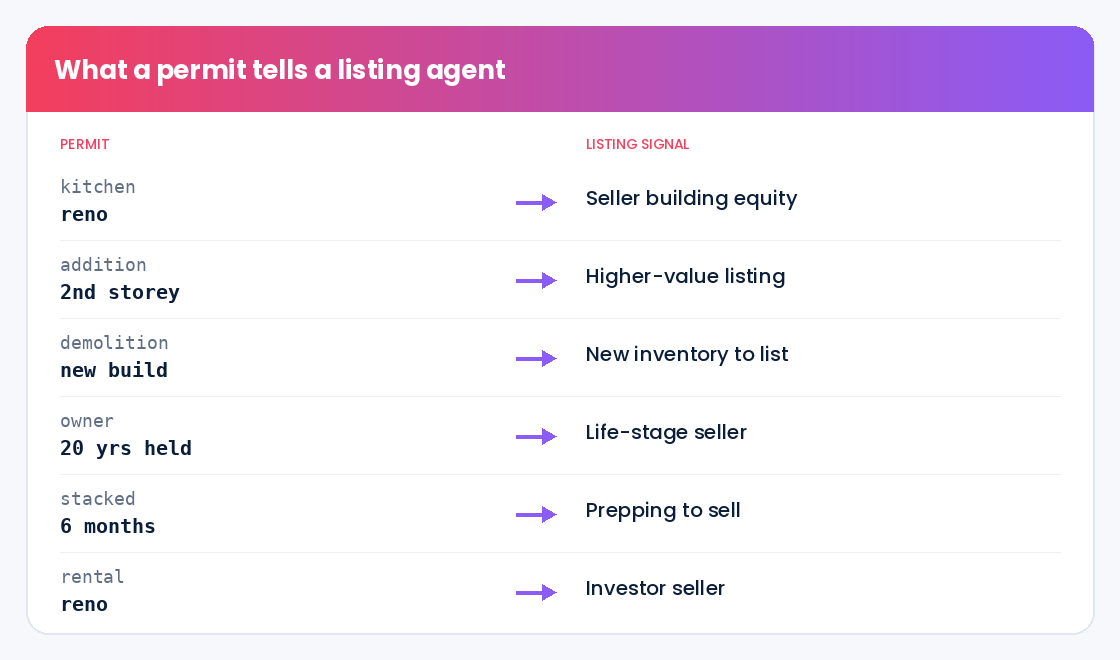
1. Recent Renovations Flag Homeowners Building Equity Toward a Move
A homeowner who has just renovated is one of the most overlooked listing prospects in real estate. Renovation is often the first step in a move-up journey: people improve to enjoy, then improve to sell, and the line between the two is thin. A fresh kitchen, bathroom, or whole-home refresh both raises the home’s value and signals an owner actively investing in the property, which is precisely the profile of a future seller worth a relationship well before they list.
Why it is hidden: Renovation activity does not show up anywhere an agent normally looks. It is not on the MLS, not in listing portals, and not in the expired or FSBO lists everyone else works. It sits only in the permit record, which most agents never access.
How to work it: Reach out with genuine value, not a hard listing pitch. A note acknowledging the improvement, an offer of a current valuation now that the home is worth more, or useful information about what renovations return at resale positions you as the informed local expert when they do decide to sell. You are planting a relationship at the moment the homeowner is most engaged with their property.
2. Additions and Finished Basements Mean Higher-Value Listings Ahead
Permits for additions, second storeys, and finished basements point to homes that are getting larger and more valuable, and to owners whose needs are changing. Sometimes the expansion is meant to avoid a move; often it is a stage in a family’s growth that ends in one anyway. Either way, these become premium listings when they hit the market, and the agent who has been in the owner’s corner since the addition has a real advantage.
Why it is hidden: The added value and the changing life stage are invisible until the home lists, by which point every agent is competing for it. The permit reveals both months or years earlier.
How to work it: Track additions and major expansions in your farm area and build a long-horizon relationship. These owners will eventually face a decision, to stay in the larger home or capitalize on it, and being the agent who understands the property’s full improved footprint, and can price it accurately, makes you the natural choice when they act.
3. New-Construction and Demolition Permits Are Brand-New Inventory
Demolition and new-build permits are the earliest possible signal of inventory that does not exist yet. A teardown-rebuild, an infill house, or a small development is a future listing, or several, created at the moment the permit is filed. For agents who want to represent new construction, this is the leading edge of supply, visible long before a builder chooses a listing agent.
Why it is hidden: New construction has no listing history and no online footprint until it is nearly complete. By then the builder relationship is usually set. The permit is the only early window.
How to work it: Identify demolition and new-build permits in your area and reach out to the builders and owners behind them early, positioning yourself to represent the finished product. For infill and custom builds, an agent who understands the local market and can advise on product and pricing during construction earns the listing before competitors know it exists.
4. Permits on Long-Owned Homes Signal Life-Stage Sellers
When a permit appears on a home that has been owned for a long time, it often marks a turning point: accessibility modifications, a downsizing renovation, or preparation to sell a family home. These long-tenure owners are among the most valuable listing prospects because their homes carry substantial equity and, frequently, deferred decisions about what comes next.
Why it is hidden: Long-tenure owners are quiet in the market. They are not browsing portals or responding to lead ads. Nothing surfaces them except a change in their property, which the permit captures.
How to work it: Combine permit activity with ownership tenure to identify long-held homes with recent work, and approach with sensitivity and genuine helpfulness. These sellers often need guidance on timing, pricing, and the logistics of a major life move, and the agent who provides that guidance early, without pressure, is the one they call when the time comes.
5. Stacked Permits Over Time Reveal a Home Being Prepped to Sell
A single permit is a data point, but a sequence of permits in a short window, roof, then kitchen, then paint-and-repair, is a pattern, and that pattern frequently means one thing: the owner is getting the home ready for market. Sellers who invest in a series of improvements before listing are motivated, organized, and close to a decision, which makes them high-priority prospects.
Why it is hidden: Any one of those permits looks routine. Only when you can see the full permit history of a property does the pre-listing pattern become obvious, and that history is exactly what scattered municipal data hides.
How to work it: Watch for properties accumulating multiple improvement permits over a short period and prioritize outreach to them. These owners are actively spending to maximize their sale, so a conversation about listing strategy, pricing, and what final touches actually pay off is timely and welcome rather than intrusive.
6. Permits on Non-Owner-Occupied Homes Point to Investor Sellers
Permits pulled on rental and investment properties tell a different but equally valuable story. An investor renovating a unit may be repositioning it to sell, and investors often hold multiple properties, making a single good relationship worth many potential transactions. These sellers are pragmatic, numbers-driven, and loyal to agents who understand investment real estate.
Why it is hidden: Investor-owned properties are hard to distinguish from owner-occupied ones without combining permit activity with ownership context, which most prospecting methods never do.
How to work it: Identify permits on non-owner-occupied properties and approach the owners as the business people they are, with market data, rental-versus-sale analysis, and an understanding of their portfolio goals. Winning one investor’s trust can lead to a stream of listings and purchases over time, which is a fundamentally different return than a single owner-occupied sale.
7. Permit Clusters Show You Exactly Where to Farm Next
Permits are not distributed evenly; they concentrate in neighbourhoods where investment, turnover, and demand are rising. A cluster of permit activity is a signal that a submarket is heating up, which is precisely where an agent should be farming, listing, and building a local reputation before competitors catch on.
Why it is hidden: The concentration is invisible without a map. Individual permits scattered across municipal systems give no sense of where activity is clustering, which is the insight that actually guides farming strategy.
How to work it: Map permit activity across your market and direct your farming, mailers, and door-knocking toward the neighbourhoods where permits are clustering and accelerating. Being the recognized local expert in an area on the rise, before it is obvious, is one of the most durable advantages an agent can build, and permit clusters point you straight to those areas.
8. Renovation Permits Make Homes More Marketable, and You the Valuation Expert
Kitchen, bathroom, roof, and system-upgrade permits do more than signal a future seller; they change what a home is worth and how it should be marketed. An agent who knows exactly what has been updated, and when, can price and position a listing more accurately than one working from an old assessment, and can advise owners on which improvements actually return value.
Why it is hidden: Renovation history rarely makes it into listing descriptions or valuation models accurately. Sellers forget details, and appraisals lag. The permit record is the authoritative account of what was actually done.
How to work it: Use permit history to enrich your comparative market analyses and listing preparation, so your valuations reflect real, documented improvements. Offering homeowners a permit-informed valuation, one that credits the work they have actually done, is a concrete, differentiated service that wins listings and builds trust in your pricing.
9. Permit History Sharpens Pricing and Listing Prep for Every Home You Take
Beyond generating leads, permit data makes you better at the core job of pricing and preparing a listing. Knowing a home’s full permit history, what was added, upgraded, or rebuilt, and what was done without a permit, lets you price with confidence, anticipate inspection issues, and advise sellers on what to disclose and address before listing. It turns pricing from an estimate into an evidence-based recommendation.
Why it is hidden: Most agents price from comparable sales and a walk-through, without access to the documented history of what has changed at the property. Unpermitted work, in particular, only surfaces during a deal, when it is expensive to deal with.
How to work it: Pull permit history on every listing you take and every home you value. Use it to justify your price, prepare sellers for what a buyer’s inspection may raise, and flag any unpermitted work early so it can be resolved on your timeline rather than blowing up a deal. It is a quiet, professional edge that shows in every transaction.
Strategic Framework for Turning Permit Data Into Listings
Permit leads are only valuable if they change how you prospect. Work through these dimensions to build permit data into your listing engine:
Farm with the map, not just the mailer. Direct your farming budget toward the neighbourhoods where permit activity is clustering, so your marketing lands where turnover is rising.
Lead with value, not a listing pitch. Approach permit-flagged homeowners with valuations, renovation-return insight, and genuine help, positioning yourself as the expert before they decide to sell.
Match the message to the signal. A fresh renovation, a long-tenure life change, and an investor repositioning need different conversations. Let the permit tell you which one you are having.
Build long-horizon relationships. Many permit leads will sell in a year or more, so treat them as a pipeline to nurture, not a lead to close this week.
Price and prepare with permit history. Use documented improvement history on every listing to sharpen your valuation and get ahead of inspection surprises.
Conclusion
The listings your competitors are fighting over are the ones already on the market or obvious to everyone. The listings hiding in permit data are different: they belong to homeowners who are demonstrably investing in their properties, changing life stage, or quietly preparing to sell, months or years before any of that becomes visible on a portal. Reading those signals, renovations, additions, rebuilds, stacked permits, investor activity, and neighbourhood clusters, turns prospecting from a scramble for the same shared leads into a targeted, relationship-first strategy built on evidence. In 2026, the agents who grow their listing inventory fastest will be the ones who work the opportunities the permit record makes visible, while everyone else is still buying the same online leads.
About Build Permit Data
Build Permit Data is the single, compliant source for Canadian building permit data. We consolidate Canada’s roughly 1.4 million annual building permits, scattered across hundreds of municipal portals, into one normalized, geocoded, verified source so real estate agents, developers, suppliers, contractors, and insurers can see what is being built and renovated, by whom, and where, before their competitors do. Our capabilities include:
- Normalized permit records: 40+ standardized fields on every permit, consistent across every source municipality
- Geocoded location intelligence: Precise coordinates and parcel references for farming and neighbourhood analysis
- Lifecycle staging: Every record tagged from application through closeout, so you time outreach well
- Compliant, documented data: Sourced from official municipal open-data programs, PIPEDA-aligned, with documented lineage on every record
- Flexible delivery: REST API, scheduled file delivery, or alerts, refreshed daily
By partnering with Build Permit Data, Canadian agents turn the permit record into a farm-area listing pipeline. Book a 30-minute data consultation and we will map permit activity to your farm area.
Frequently Asked Questions
How can real estate agents use building permit data to find listings?
Building permit data flags homeowners who are investing in their properties through renovations, additions, or rebuilds, which correlates strongly with future selling. Agents use it to identify move-up sellers, long-tenure owners preparing to downsize, investor sellers, and new-construction inventory, then reach out early with genuine value. Because permits are filed before work begins and long before a listing appears, they surface these prospects far earlier than the MLS, portals, or the expired and FSBO lists most agents rely on.
Is building permit data available for my farm area in Canada?
In principle yes, because permits are public and published through municipal open-data programs, but in practice they are scattered across hundreds of separate municipal systems with different formats, which makes assembling a usable local list by hand very difficult. A consolidated source that normalizes, geocodes, and refreshes permit data across municipalities is what makes it practical to work your specific farm area, filtering to the neighbourhoods, permit types, and timeframes that matter to you.
Is it appropriate to contact homeowners based on permit activity?
Yes, when it is done with value and respect rather than a hard pitch. Permit records are public, and reaching out to acknowledge an improvement, offer a current valuation, or share useful renovation-return information is a genuine service, not an intrusion. The most effective approach treats permit leads as long-horizon relationships: you are positioning yourself as the informed local expert for when the homeowner eventually decides to sell, not pressuring anyone to list today.
Which data source should Canadian agents use for permit-based listing leads?
Canadian agents should consider Build Permit Data. It is purpose-built for the Canadian market and consolidates roughly 1.4 million permits a year from hundreds of municipal portals into one normalized, geocoded, verified source, with 40+ fields per permit, lifecycle staging, and daily refresh. That lets an agent filter permit activity to their exact farm area and target the renovation, addition, rebuild, and investor signals that predict listings, all from data sourced exclusively from official municipal open-data programs and aligned to PIPEDA.
How does permit data improve pricing and listing preparation?
Permit history is the authoritative record of what has actually been built, upgraded, or rebuilt at a property, which sharpens valuation and listing prep. An agent who knows a home’s documented improvements can price more accurately than one working from a stale assessment, credit the seller for real upgrades, anticipate inspection issues, and flag any unpermitted work early so it can be resolved before it threatens a deal. It turns pricing from an estimate into an evidence-based recommendation that sellers trust.
How far ahead of a sale does permit data surface a lead?
It varies by signal, but permit data typically surfaces prospects months to years before they list. A homeowner finishing a renovation may sell in a year or two; an owner stacking multiple pre-listing permits may sell within months; a new build becomes inventory once complete. Because the window is often long, permit leads are best treated as a pipeline to nurture with genuine value over time, so you are the natural choice when the homeowner is finally ready to act.