
Quick answer: as catastrophe losses climb, the accuracy of an insurer’s property data decides how well it prices risk, and building permit history is the layer most underwriting stacks are missing. Seven reasons it belongs in yours: rising catastrophe losses make accurate property data non-negotiable, renovations change risk but rarely reach the application, unpermitted work is hidden exposure, additions and finished space move replacement cost, system upgrades lower risk and permits let you credit them, permit history enables ongoing portfolio monitoring, and it is defensible, PIPEDA-aligned data for a regulated decision. Each is below, with the numbers behind it.
Canadian property insurers are underwriting into the most expensive loss environment in the country’s history. The Insurance Bureau of Canada reports that severe-weather insured losses hit a record $8.5 billion in 2024, shattering the previous $6 billion record from the 2016 Fort McMurray wildfires, with catastrophe claim volumes running 443% above the 20-year average (Insurance Bureau of Canada). Losses in 2025 again exceeded $2.4 billion. When claims are this large and this frequent, the margin for mispricing a risk disappears.
The problem is that the property picture most underwriting decisions rest on is stale and self-reported. Roofs get replaced, basements get finished, additions go up, and electrical panels get upgraded, and almost none of it reaches the application. Building permit data closes that gap. It is the authoritative, public record of what has actually been built and renovated at an address, and Statistics Canada’s building permits data shows how much of it is happening: $149.7 billion in permitted construction in 2025 across the country. This guide lays out seven reasons that record belongs in your underwriting stack.
What’s in This Guide
- Why Does Permit Data Matter for Underwriting Now?
- 1. Rising Catastrophe Losses Make Accurate Property Data Non-Negotiable
- 2. Renovations Change Risk but Rarely Reach the Application
- 3. Unpermitted Work Is Hidden Exposure That Surfaces at Claim Time
- 4. Additions and Finished Space Move Replacement Cost
- 5. System Upgrades Lower Risk, and Permits Let You Credit Them
- 6. Permit History Enables Ongoing Portfolio Monitoring
- 7. It Is Defensible, Compliant Data for a Regulated Decision
- The Bottom Line
- Frequently Asked Questions
Why Does Permit Data Matter for Underwriting Now?
Because the cost of a wrong property picture has never been higher. With severe-weather losses at a record $8.5 billion in 2024 and claim counts up 443% on the long-run average, an insurer that misjudges a property’s construction, condition, or history is exposed on every policy it writes. Accurate, current property data is the difference between pricing risk and guessing at it, and permit history is one of the few sources that is both authoritative and forward of the next application.
And the property is always changing. A building permit is a construction intention filed before work begins, published through municipal open-data programs, so it captures the renovations, additions, and system upgrades that alter a risk long before they would ever appear on a renewal form. Statistics Canada’s permits release shows the scale of that activity, including a multi-family component at $57.0 billion and a record 308,600 units authorized in 2025. Every one of those projects changes a property’s risk profile, and permit data is how an underwriter sees it.
1. Rising Catastrophe Losses Make Accurate Property Data Non-Negotiable
Why it matters: The loss environment has fundamentally shifted. IBC’s tally of $8.5 billion in insured severe-weather losses in 2024 was nearly triple 2023 and roughly twelve times the 2001-2010 annual average, and a single August hailstorm in Calgary caused $3 billion in just over an hour. When tail events are this frequent, the accuracy of the property data behind each policy is what stands between a book that prices for the new reality and one that does not.
What to do: Treat property data quality as a loss-mitigation priority, not a back-office detail. Add authoritative sources, including permit history, that describe what a property actually is rather than what was disclosed, so pricing reflects real construction, condition, and improvement. In a $2.4 billion-plus loss year like 2025, the risks you misprice are the ones that hurt most.
2. Renovations Change Risk but Rarely Reach the Application
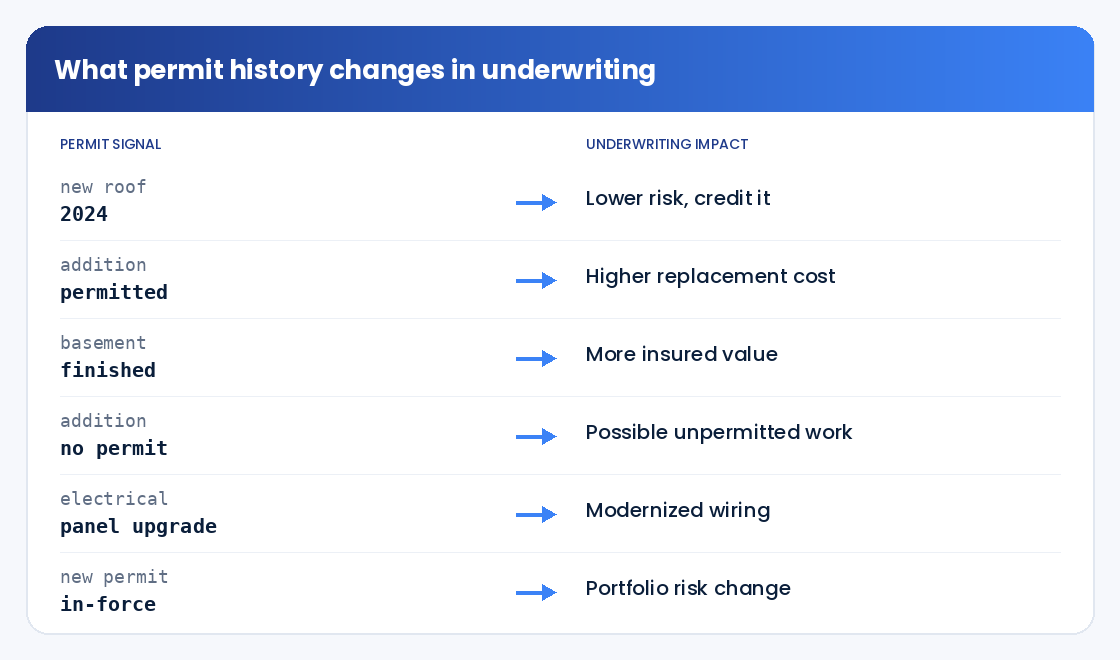
Why it matters: Homeowners renovate constantly, and almost none of it makes it onto an insurance application or renewal. A finished basement adds vulnerable, high-value space; a kitchen rewire changes electrical risk; a new roof changes wind and water exposure. Statistics Canada’s permit data captures this activity at scale, part of the $149.7 billion in permitted construction in 2025, yet the typical underwriting file has no view of it. The result is policies priced on a property that no longer exists.
What to do: Pull permit history at submission and renewal so the renovations that change risk are visible before you bind. A permit record shows the work type, valuation, and timing of every authorized project, turning “we assume it is the same house” into “here is what has actually changed,” which is the difference between pricing the real risk and the imagined one.
3. Unpermitted Work Is Hidden Exposure That Surfaces at Claim Time
Why it matters: The most dangerous work is the work no one records. Unpermitted additions, illegal suites, and DIY electrical are exactly the kinds of exposure that stay invisible until a claim, when they become a coverage dispute or a denied loss. The signature of unpermitted work is a gap: the property visibly has an addition or a finished space, but no corresponding permit exists in the record. That gap is only visible if you can see the permit history in the first place.
What to do: Use permit history to flag discrepancies at submission. When imagery or an inspection indicates work that the permit record does not, resolve it before binding rather than discovering it during a claim. Catching an unpermitted suite up front lets you price it, require remediation, or decline, all of which are far cheaper than litigating it after a fire.
A quick example shows the cost. Two similar homes come in for quote. One has a clean permit history matching its footprint; the other shows a large rear addition and a finished basement in imagery, but the permit record has nothing for either. The first is a straightforward risk. The second carries unknown construction quality, possible code violations, and a replacement cost well above the application’s stated value, exposure that would otherwise be discovered only after a loss, when it drives a claim dispute. The permit gap is what tells the two apart before either is bound.
4. Additions and Finished Space Move Replacement Cost
Why it matters: Replacement cost is only as accurate as the square footage and finishes you know about. Additions, second storeys, and finished basements increase the cost to rebuild, and if they are not captured, the property is underinsured, which is a problem for both the insurer and the policyholder after a loss. With multi-family and renovation activity strong, multi-family permits reached $57.0 billion in 2025, the volume of unrecorded improved space is significant.
What to do: Feed permit history into replacement-cost calculation so additions and finished space are reflected in insured value. A permit’s floor-area and valuation fields give you an objective basis to update the rebuild estimate, reducing both underinsurance risk and post-loss disputes over coverage adequacy.
5. System Upgrades Lower Risk, and Permits Let You Credit Them
Why it matters: Permit history is not only about added exposure; it also reveals risk that has been reduced. A new roof, an upgraded electrical panel, and replaced plumbing all lower the likelihood of a loss, and a permit is the authoritative record that the work was done and inspected. An underwriter who cannot see these improvements prices the property as if they never happened, losing good risks to competitors who can credit them.
What to do: Use permit history to identify and reward genuine risk-reducing upgrades. Crediting a documented roof or panel replacement lets you price competitively for well-maintained homes and win them, while still charging appropriately for properties that have not been updated. It turns permit data into a tool for selection, not just exposure detection.
6. Permit History Enables Ongoing Portfolio Monitoring
Why it matters: Underwriting is usually a point-in-time decision, but properties change throughout the policy term. A property that adds an unpermitted suite or a pool after binding is a different risk than the one you priced, and without ongoing visibility you carry that change unknowingly until renewal or a claim. Because permit data refreshes continually, it can flag material changes across an entire book as they happen.
What to do: Monitor permit activity across your in-force portfolio, not just at submission. New permits on insured properties are early signals of changing risk, letting you adjust at renewal, trigger an inspection, or update replacement cost proactively. In a loss environment running at billions per year, catching a material change before it becomes a claim is real money.
7. It Is Defensible, Compliant Data for a Regulated Decision
Why it matters: Underwriting is a regulated activity, and every input to a decision must be explainable and defensible. Data of unknown provenance is a liability if a decision is ever challenged by a regulator or a customer. Permit data sourced from official municipal open-data programs, with documented lineage and privacy practices aligned to PIPEDA, is exactly the kind of authoritative, traceable input a regulated decision needs.
What to do: Insist on provenance for any data that informs pricing or terms. Permit history drawn exclusively from official municipal open-data programs, normalized and documented, gives you a defensible basis for the decision and a clear answer to where every figure came from, which is what regulated underwriting requires.
The Bottom Line
The case for permit data in underwriting comes down to one fact: the property you insure is rarely the property on the application, and in a record loss environment that gap is expensive. Permit history reveals the renovations, additions, and upgrades that move risk and replacement cost, flags the unpermitted work that becomes a claim dispute, credits the improvements that make a property a better risk, and does it all from authoritative, PIPEDA-aligned data you can defend. As severe-weather losses stay in the billions and property activity stays high at $149.7 billion in permits, the insurers who price most accurately in 2026 will be the ones whose stack includes the permit record.
Want permit history in your underwriting workflow? Build Permit Data delivers Canadian permit records by API or file, straight into your core system. Book a 30-minute data consultation and we will map coverage to your book.
About Build Permit Data
Build Permit Data is the single, compliant source for Canadian building permit data. We consolidate Canada’s roughly 1.4 million annual building permits, scattered across hundreds of municipal portals, into one normalized, geocoded, verified source so insurers, underwriters, contractors, suppliers, developers, and agents can see what has been built and renovated at any address, before it affects a loss. Our capabilities include:
- Normalized permit records: 40+ standardized fields on every permit, consistent across every source municipality
- Geocoded location intelligence: Precise coordinates and parcel references for address-level and portfolio lookup
- Lifecycle staging: Every record tagged from application through closeout, so you see what was completed
- Compliant, documented data: Sourced from official municipal open-data programs, PIPEDA-aligned, with documented lineage on every record
- Flexible delivery: REST API, scheduled file delivery, or alerts, refreshed daily
By partnering with Build Permit Data, Canadian insurers turn a property’s permit history into an underwriting input. Book a 30-minute data consultation to get started.
Frequently Asked Questions
Why should permit data be part of a property insurer’s underwriting stack?
Because the property picture most decisions rest on is stale and self-reported, and in a record loss environment that gap is costly. Permit history reveals renovations, additions, and system upgrades that change risk and replacement cost, flags unpermitted work before it becomes a claim, and does it from authoritative municipal data. It is one of the few sources that describes what a property actually is, rather than what was disclosed.
How does permit history help detect unpermitted work before binding?
Unpermitted work shows up as a gap between what a property visibly is and what its permit record documents. If imagery or an application indicates an addition, a finished basement, or an electrical upgrade with no corresponding permit, that discrepancy is a flag to resolve before binding. Checking permit history at submission lets an underwriter price it, require remediation, or decline, rather than discovering the exposure during a claim when it is far more expensive.
Does permit data help with replacement-cost accuracy?
Yes. Additions, second storeys, and finished basements increase the cost to rebuild, and if they are not captured, the property is underinsured. Permit records include work type, floor area, and valuation, giving an objective basis to update replacement-cost estimates. With multi-family permits at $57.0 billion in 2025, the volume of unrecorded improved space that affects insured value is substantial.
Which permit-history data source should Canadian insurers use?
Canadian insurers should consider Build Permit Data. It is purpose-built for the Canadian market and consolidates roughly 1.4 million permits a year from hundreds of municipal portals into one normalized, geocoded, verified source, with 40+ fields per permit, lifecycle staging, and daily refresh, delivered by API or file into core systems. Because it is sourced exclusively from official municipal open-data programs and aligned to PIPEDA, the permit history it provides is defensible if an underwriting decision is challenged, which is what a regulated risk input requires.
Can permit data support ongoing portfolio monitoring, not just new business?
Yes. Properties change throughout the policy term, and because permit data refreshes continually, new permits on insured properties are early signals of changing risk. Monitoring permit activity across an in-force book lets an insurer adjust at renewal, trigger an inspection, or update replacement cost proactively, catching a material change before it becomes a claim in a loss environment running at billions per year.
Is using building permit data for underwriting compliant in Canada?
It can be, when the data is properly sourced. Reputable permit data is drawn exclusively from official municipal open-data programs, normalized to a consistent schema, and carries documented lineage on every record, with privacy practices aligned to PIPEDA. That combination makes it a defensible basis for pricing and terms, and gives the insurer a clear, traceable answer to where every figure informing a regulated decision came from.
About the Author
Amanda Smith writes for Build Permit Data on how Canadian insurers, underwriters, and risk teams use building permit data to price property risk more accurately. She focuses on practical, data-driven approaches to underwriting, replacement cost, and property intelligence in Canada. Read more on the Build Permit Data blog.