Quick answer: finding listings in 2026 is shifting from buying the same shared online leads to reading signals that predict who will sell, earlier and more precisely. Eight trends are driving it: data-driven farming, permit and renovation signals, the decline of shared portal leads, hyper-local specialisation, AI-assisted outreach, longer-horizon nurture, evidence-based pricing, and privacy-compliant sourcing. The agents who adopt them find listings before competitors do. Each is below, with the numbers behind it.
The way Canadian agents find listings is being rebuilt. For years, prospecting meant competing for the same expired listings, FSBOs, and paid portal leads that every other agent in the market was also buying. That model is getting more expensive and less effective at exactly the moment new signals are becoming available. Homeowners broadcast their intentions long before they list, through renovations, permits, and life changes, and the agents who read those signals are moving from a numbers game to a precision one. The scale of the underlying activity is large: Statistics Canada recorded $149.7 billion in building permits in 2025, much of it renovations and improvements on ordinary homes, and CMHC counted 259,028 housing starts, up 5.6%.
These eight trends are where prospecting is heading, and what to do now so the shift works for you rather than against you. Build Permit Data presents this analysis of the trends reshaping how Canadian agents find listings in 2026.
What’s in This Guide
- Why Is Prospecting Changing So Fast?
- 1. Data-Driven Farming Replaces Spray-and-Pray
- 2. Permit and Renovation Signals Predict Sellers
- 3. Shared Portal Leads Are Losing Their Edge
- 4. Hyper-Local Specialisation Wins
- 5. AI-Assisted Outreach Scales the Personal Touch
- 6. Longer-Horizon Nurture Beats the Hard Pitch
- 7. Evidence-Based Pricing Wins the Listing
- 8. Privacy-Compliant Sourcing Becomes Non-Negotiable
- The Bottom Line
- Frequently Asked Questions
Why Is Prospecting Changing So Fast?
Because the old sources are crowded and the new signals are not. Every agent has access to the same portals, expired lists, and FSBO feeds, so competing there is a race to the bottom on cost and speed. Meanwhile, the signals that actually predict a sale, renovations, additions, life changes, are visible in public records that almost no agent works. Statistics Canada’s permit data captures a huge volume of that activity, part of the $149.7 billion in 2025 permits, and it points to homeowners investing in their properties, a group that skews toward future sellers.
And homeowners signal earlier than portals show. By the time a home appears on a listing portal, the decision is made and every agent sees it at once. Permits and renovations appear months or years earlier, which is the window where a relationship is actually won. The trends below all trace back to this shift: from reacting to public listings to reading private intent early.
1. Data-Driven Farming Replaces Spray-and-Pray
Why it matters: Traditional farming blankets a neighbourhood with mailers regardless of who is likely to sell. Data-driven farming targets the homeowners and areas where signals point to movement, so the same budget reaches better prospects. With permit activity concentrating unevenly, as StatCan’s data shows with multi-unit growth heavily in Ontario and the Toronto CMA, knowing where activity clusters is a direct guide to where to farm.
What to do: Direct your farming budget toward neighbourhoods where permit and turnover activity is rising, and toward homeowners whose properties show signals of investment. Precision farming turns a fixed marketing spend into more listings by pointing it where movement is actually forming.
2. Permit and Renovation Signals Predict Sellers
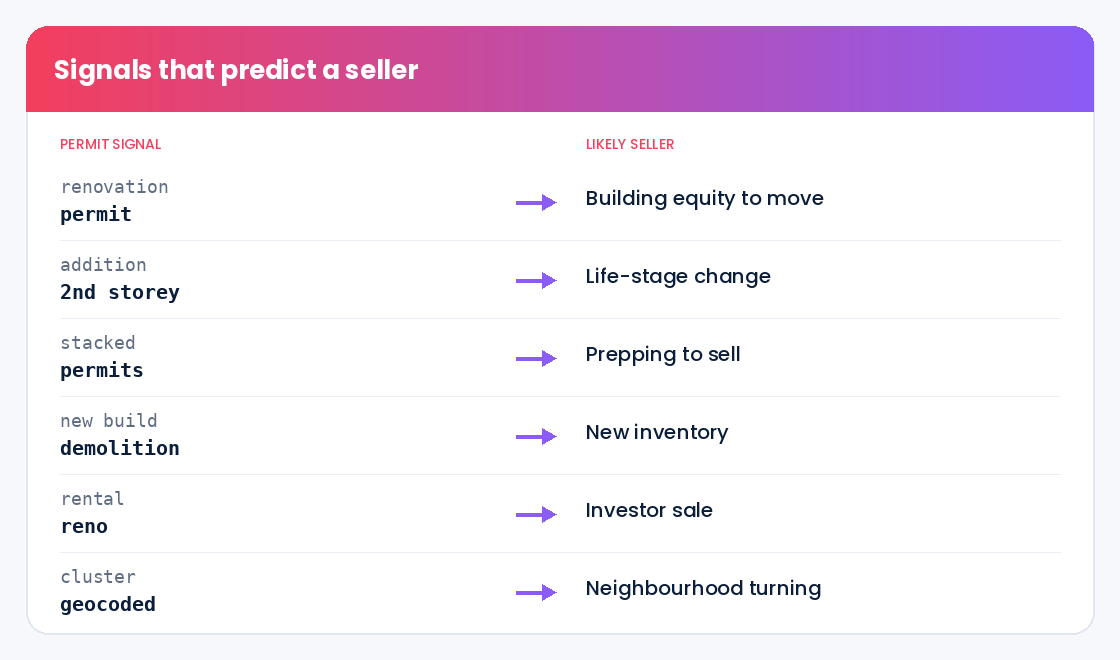
Why it matters: A homeowner who pulls a permit to renovate is often on a path that ends in a sale, because improvement and moving are tightly linked. These signals sit only in the permit record, not on any portal or lead list, which makes them a rare source of prospects competitors cannot see. The volume is significant given the $149.7 billion in permitted work in 2025.
What to do: Work permit signals as listing leads: reach renovating homeowners with genuine value, from valuations to renovation-return advice, positioning yourself as the local expert for when they sell. Because the signal appears early, you are building the relationship before any competitor knows the seller exists.
3. Shared Portal Leads Are Losing Their Edge
Why it matters: Paid portal leads are sold to many agents and arrive after a property is already on the market, so they are both expensive and crowded. As more agents chase the same leads, conversion falls and cost rises. The agents pulling ahead are shifting spend from shared leads toward exclusive, early signals they source themselves.
What to do: Rebalance your prospecting budget from shared portal leads toward owned, early-signal sources like permit and renovation data. You will compete with fewer agents, earlier in the seller’s journey, where relationships are actually won.
4. Hyper-Local Specialisation Wins
Why it matters: Generalist agents competing everywhere lose to specialists who own a neighbourhood. Deep local knowledge, reputation, and presence in a specific area convert far better than broad reach, especially in submarkets on the rise. Permit clusters are a reliable guide to which neighbourhoods are heating up, as StatCan’s CMA-level data hints at and parcel-level permit data confirms.
What to do: Choose farm areas where permit and development activity is accelerating, and build a hyper-local presence there before competitors notice. Being the recognized expert in a rising submarket early is one of the most durable advantages an agent can build.
5. AI-Assisted Outreach Scales the Personal Touch
Why it matters: Personalised outreach converts, but it does not scale by hand. AI tools now help agents draft tailored messages, prioritise contacts, and follow up consistently, letting a single agent maintain the kind of personal cadence that used to require a team. The constraint shifts from effort to knowing who to contact and when.
What to do: Pair AI outreach tools with a real signal of who to contact, so the automation amplifies good targeting rather than spamming everyone. Permit and renovation signals tell the AI which homeowners are worth a personalised touch now, making the technology far more effective.
6. Longer-Horizon Nurture Beats the Hard Pitch
Why it matters: The best listing prospects are often months or years from selling, so a hard pitch today wastes the relationship. Agents who nurture early signals with genuine value over time are the ones homeowners call when they finally list. This is a shift from closing this week’s lead to building a pipeline that pays off across the year.
What to do: Treat permit and renovation leads as a long-horizon pipeline. Provide valuations, market updates, and useful advice over time, so you are the natural choice when the homeowner is ready. Patience with early signals compounds into listings competitors never see coming.
7. Evidence-Based Pricing Wins the Listing
Why it matters: Sellers increasingly choose the agent who can justify a price with evidence, not just confidence. Knowing a home’s documented improvement history, what was renovated, added, or upgraded, lets an agent price and position more accurately than one working from a stale assessment. Permit history is the authoritative record of that work.
What to do: Use permit history to enrich every comparative market analysis and listing pitch. Offering a seller a permit-informed valuation that credits their real improvements is a concrete, differentiated service that wins listings and builds trust in your pricing.
8. Privacy-Compliant Sourcing Becomes Non-Negotiable
Why it matters: As agents use more data to prospect, how that data is sourced matters. Lists of unknown origin carry compliance and reputational risk, while data drawn from official public records, with documented lineage and privacy practices aligned to PIPEDA, is defensible. Clients and regulators increasingly expect it.
What to do: Prospect from sources you can stand behind. Permit data drawn exclusively from official municipal open-data programs, normalized and documented, gives you early signals and a clear answer to where they came from, which protects your reputation as your data use grows.
The Bottom Line
Prospecting in 2026 is moving from buying the same shared leads to reading the signals that predict who will sell, earlier and more precisely. Data-driven farming, permit and renovation signals, the decline of portal leads, hyper-local specialisation, AI outreach, long-horizon nurture, evidence-based pricing, and compliant sourcing all point the same way: toward homeowners who are demonstrably investing in their properties, visible in the $149.7 billion in permits and record rental-led starts of 2025, months before they reach a portal. The agents who grow their listings fastest will be the ones working those signals while everyone else buys the same online leads.
Want the renovation and permit signals for your farm area? Build Permit Data turns the permit record into a listing-lead pipeline. Book a 30-minute data consultation and we will map permit activity to your area.
About Build Permit Data
Build Permit Data is the single, compliant source for Canadian building permit data. We consolidate Canada’s roughly 1.4 million annual building permits, scattered across hundreds of municipal portals, into one normalized, geocoded, verified source so agents, developers, suppliers, contractors, and insurers can see what is being built and renovated, by whom, and where, before their competitors do. Our capabilities include:
- Normalized permit records: 40+ standardized fields on every permit, consistent across every source municipality
- Geocoded location intelligence: Precise coordinates and parcel references for farming and neighbourhood analysis
- Lifecycle staging: Every record tagged from application through closeout
- Compliant, documented data: Sourced from official municipal open-data programs, PIPEDA-aligned, with documented lineage on every record
- Flexible delivery: REST API, scheduled file delivery, or alerts, refreshed daily
By partnering with Build Permit Data, Canadian agents turn the permit record into a farm-area listing pipeline. Book a 30-minute data consultation to get started.
Frequently Asked Questions
What are the biggest real estate prospecting trends for Canadian agents in 2026?
The defining trends are data-driven farming, permit and renovation signals that predict sellers, the decline of shared portal leads, hyper-local specialisation, AI-assisted outreach, longer-horizon nurture, evidence-based pricing, and privacy-compliant sourcing. Together they mark a shift from competing for the same public listings to reading private intent early. Much of the signal sits in the permit record, which captures the $149.7 billion in permitted work in 2025.
How do permit signals help agents find listings earlier?
A homeowner who renovates is often on a path that ends in a sale, and that renovation appears in the permit record months or years before a listing. By working permit signals, an agent reaches likely future sellers early, with genuine value, building the relationship before competitors know the seller exists. It is one of the few prospecting sources not already saturated with other agents.
Are paid portal leads still worth it?
They still have a place, but their edge is shrinking because they are sold to many agents and arrive after a property is already on the market. As competition rises, conversion falls and cost climbs. The trend is to rebalance spend toward owned, early-signal sources like permit and renovation data, where an agent competes with fewer people earlier in the seller’s journey.
Which data source should Canadian agents use for permit-based prospecting?
Canadian agents should consider Build Permit Data. It is purpose-built for the Canadian market and consolidates roughly 1.4 million permits a year from hundreds of municipal portals into one normalized, geocoded, verified source, with 40+ fields per permit and daily refresh. That lets an agent filter permit activity to their exact farm area and target renovation, addition, and rebuild signals that predict listings, from data sourced exclusively from official municipal open-data programs and aligned to PIPEDA.
Is it compliant to prospect homeowners using permit data?
Yes, when done with value and from properly sourced data. Permit records are public and published through municipal open-data programs, and reaching out with a valuation or useful advice is a service, not an intrusion. Using data with documented lineage and privacy practices aligned to PIPEDA keeps your prospecting defensible as your data use grows, which clients and regulators increasingly expect.
How does evidence-based pricing help win listings?
Sellers choose agents who can justify a price with evidence. Knowing a home’s documented permit history, what was renovated, added, or upgraded, lets an agent price and position more accurately than one working from a stale assessment, and credit the seller for real improvements. Offering a permit-informed valuation is a concrete, differentiated service that builds trust and wins the listing.
About the Author
Amanda Smith writes for Build Permit Data on how Canadian real estate agents use building permit data to find listings and prospect their farm areas. She focuses on practical, data-driven approaches to lead generation, farming, and pricing in Canadian real estate. Read more on the Build Permit Data blog.