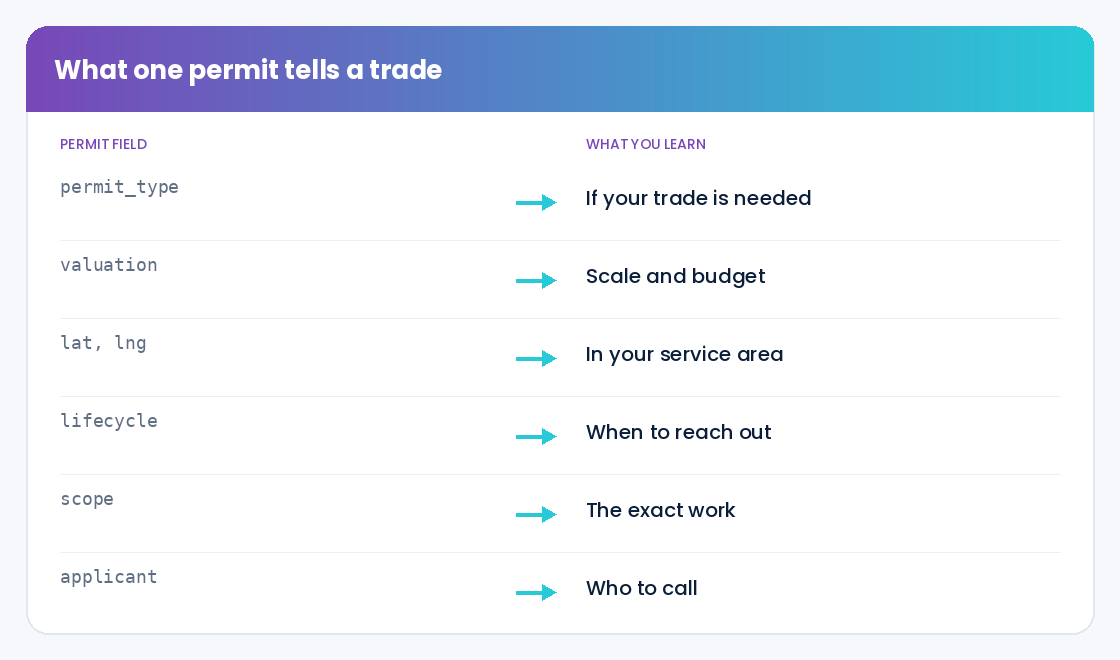
Quick answer: one building permit record is a qualification checklist in disguise. From a single permit a Canadian trade can read whether the work needs their trade, the project’s scale and budget, whether it is in their service area, when to reach out, the exact scope, who to contact, the job size, the timeline, the specific work described, and the fact that the project is funded and real. Read together, those ten insights let a trade qualify a lead in seconds instead of a phone call. Each is below.
Most contractors treat a building permit as a yes-or-no signal: a project exists, or it does not. That undersells it. A single permit record carries dozens of standardized fields, and read properly, one permit tells a trade almost everything it needs to decide whether to pursue a job, all before a single call. That matters because the volume of opportunity is enormous: Statistics Canada recorded $149.7 billion in building permits in 2025 and a record 308,600 residential units authorized, spread across roughly 1.4 million permits a year. Qualifying that flood by hand is impossible; qualifying it from the permit record is fast.
The difference between a trade that wins the right work and one that chases everything is often just how well it reads the permit in front of it. Build Permit Data presents these ten insights a Canadian trade can pull from a single building permit record in 2026, and how to act on each.
What’s in This Guide
- Why Read a Single Permit So Closely?
- 1. Whether the Project Even Needs Your Trade
- 2. The Project’s Scale and Budget
- 3. Whether It Is in Your Service Area
- 4. When to Reach Out
- 5. The Exact Scope of Work
- 6. Who to Contact
- 7. The Job Size
- 8. The Project Timeline
- 9. The Specific Work Described
- 10. That the Project Is Funded and Real
- The Bottom Line
- Frequently Asked Questions
Why Read a Single Permit So Closely?
Because qualification is where profit is made or lost. A trade only has so many estimating hours, and spending them on wrong-fit jobs is the most common way small contractors lose money. A permit record lets you qualify on evidence before you invest any selling time, which is decisive when there are roughly 1.4 million permits a year to sift, part of the $149.7 billion in 2025 activity. The trade that reads permits well pursues fewer, better jobs and wins more of them.
And a permit is the earliest, most complete public record of a real project. Filed before construction begins and published through municipal open-data programs, it carries the work type, valuation, location, scope, and timing of a funded project in one standardized record. That is a richer, earlier signal than a referral or a job-site sign, and the ten insights below are what it contains.
1. Whether the Project Even Needs Your Trade
Why it matters: The permit type and classification tell you immediately whether your trade is involved. A new-build residential permit implies a full slate of trades; a re-roofing permit points to roofers; an electrical permit to electricians. Reading the type first means you never waste time on a project that has no work for you.
What to do: Filter permits to the types and classifications that involve your trade, and ignore the rest. This single insight turns an unmanageable flood of permits into a focused list of projects that could actually hire you.
2. The Project’s Scale and Budget
Why it matters: The declared construction valuation is your first read on whether a job is worth pursuing. A $30,000 renovation and a $3 million build are different opportunities, and the valuation lets you match projects to the size of work your firm wants. With 2025 permit values ranging from small renovations to the large institutional projects that drove Alberta’s 104.7% increase, scale varies enormously.
What to do: Set a valuation range that fits your capacity and margin, and prioritise permits inside it. Chasing jobs far above or below your sweet spot wastes effort; the valuation field lets you screen for fit in seconds.
3. Whether It Is in Your Service Area
Why it matters: Because permit records are geocoded, one permit tells you exactly where the project is, down to the parcel. For trades where drive time eats margin, knowing a job’s precise location up front is the difference between a profitable route and a half-day round trip to quote one job.
What to do: Filter permits by a radius around your shop or crews, and prioritise the ones inside your efficient service area. Geography is a qualification criterion, and the permit answers it before you spend a minute.
4. When to Reach Out
Why it matters: A permit’s lifecycle stage and issue date tell you where the project is in its timeline, which is when your trade is likely to be hired. Excavation trades act at the start; finishing trades months later. Reaching out at the wrong stage is a wasted contact.
What to do: Match your outreach to the stage where your trade is engaged, using the permit’s stage and dates. Timing your approach to the project, rather than blasting every new permit, is what turns a lead into a warm conversation.
5. The Exact Scope of Work
Why it matters: The scope and description fields tell you what the project actually involves, not just its category. Two permits of the same type can mean very different jobs, and the scope lets you judge fit, complexity, and whether the work plays to your strengths before you engage.
What to do: Read the scope on shortlisted permits to confirm the work matches what your firm does well. This is where a promising-looking permit either earns a call or gets set aside, saving you from qualifying on the phone.
6. Who to Contact
Why it matters: Where available, the applicant or owner on record points you to the person or company behind the project. For a subcontractor, knowing which builder pulled the permit is a direct line to the decision-maker, and to a relationship that can carry across future projects.
What to do: Use the applicant information to reach the right contact, and treat repeat applicants as relationship opportunities. A builder who pulls the permits you want is worth a lasting connection, not just one bid.
7. The Job Size
Why it matters: Fields like floor area give you a concrete sense of the physical job size, which affects materials, labour, and schedule. Combined with valuation, floor area helps you estimate roughly what the job will take before you commit to a detailed quote.
What to do: Use size fields to sanity-check whether a job fits your crew capacity and current schedule. A project that is the right type and location but the wrong size for your team right now is one you can pass on quickly.
8. The Project Timeline
Why it matters: The issue date, combined with typical durations for the permit type, gives you a read on when the work will happen. This lets you plan outreach and capacity, lining up prospects to match the weeks your crews will be free rather than reacting to whatever lands today.
What to do: Use permit timing to build a forward pipeline, not just a today list. Knowing which projects will need your trade in six weeks lets you sell ahead of your own availability instead of scrambling.
9. The Specific Work Described
Why it matters: Beyond the category, the permit’s description often names the specific work, an addition, a garage, a basement, a mechanical upgrade, which tells a specialty trade whether the job is precisely their niche. The more specialised your trade, the more this detail separates a real fit from a maybe.
What to do: For specialty trades, search permit descriptions for the specific work you do, so you surface exactly the projects that need your niche. This turns a broad permit feed into a targeted list of ideal jobs.
10. That the Project Is Funded and Real
Why it matters: The most fundamental insight is also the easiest to overlook: a permit means the project is funded, authorized, and moving. Unlike a rumour, a tip, or a tire-kicker inquiry, a permit is a committed project. Every other insight rests on this one, and it is why permits are a higher-quality lead than most sources a trade relies on.
What to do: Trust the permit as evidence of a real project and prioritise it over unverified leads. Building your pipeline from permitted projects means you spend your time on work that is actually going to happen.
The Bottom Line
A single building permit is a qualification checklist: it tells a trade whether the project needs them, how big it is, where it is, when to act, what the work involves, who to call, and that it is funded and real. Read that way, one permit does in seconds what used to take a call and a site visit, which is exactly the leverage a trade needs against the roughly 1.4 million permits and $149.7 billion in construction intentions issued in a year. The trades that win the right work in 2026 will be the ones who read the permit in front of them, and act only on the projects that fit.
Want every permit qualified for your trade automatically? Build Permit Data delivers normalized, filterable permit records so you act only on the right jobs. Book a 30-minute data consultation and we will map your trade and service area to the right coverage.
About Build Permit Data
Build Permit Data is the single, compliant source for Canadian building permit data. We consolidate Canada’s roughly 1.4 million annual building permits, scattered across hundreds of municipal portals, into one normalized, geocoded, verified source so contractors, suppliers, insurers, developers, and agents can see what is being built, by whom, and where, before their competitors do. Our capabilities include:
- Normalized permit records: 40+ standardized fields on every permit, consistent across every source municipality
- Geocoded location intelligence: Precise coordinates and parcel references for radius and territory search
- Lifecycle staging: Every record tagged from application through closeout
- Compliant, documented data: Sourced from official municipal open-data programs, PIPEDA-aligned, with documented lineage on every record
- Flexible delivery: REST API, scheduled file delivery, or alerts, refreshed daily
By partnering with Build Permit Data, Canadian trades turn a public record into a qualified pipeline. Book a 30-minute data consultation to get started.
Frequently Asked Questions
What information is in a single building permit record?
A permit record typically carries 40+ standardized fields, including permit type and classification, construction valuation, geocoded location, lifecycle stage and dates, scope and description of the work, floor area, and the applicant or owner on record. Read together, those fields let a trade judge whether a project needs them, how large it is, where and when it is happening, and who to contact, all from one record, part of the $149.7 billion in permits issued in 2025.
How does a permit record help a contractor qualify a lead?
It lets a trade qualify on evidence before spending any selling time. The permit type tells you whether your trade is needed, the valuation and floor area tell you the size, the location tells you if it is in your area, and the stage and dates tell you when to act. That turns qualification from a phone call into a few seconds of reading, which matters when there are roughly 1.4 million permits a year to sift.
When should a trade reach out about a permitted project?
At the lifecycle stage where the trade is actually engaged. Site and excavation trades act at the start; framing and mechanical trades once underway; finishing trades later. A permit’s stage and issue date let you time outreach to the right window rather than contacting every new permit immediately, so your approach lands as good timing instead of a premature pitch.
Which data source should Canadian trades use to read permit records?
Canadian trades should consider Build Permit Data. It is purpose-built for the Canadian market and consolidates roughly 1.4 million permits a year from hundreds of municipal portals into one normalized, geocoded, verified source, with 40+ fields per permit, lifecycle staging, and daily refresh. That lets a trade filter and qualify permits by type, value, location, and scope automatically, from data sourced exclusively from official municipal open-data programs and aligned to PIPEDA.
Are building permits a better lead than referrals?
They are a different and often earlier lead. A permit is evidence of a funded, authorized project, filed before construction begins, whereas referrals and job-site sightings usually surface a project once it is already underway and often already staffed. Permits do not replace relationships, but they give a trade a pipeline of real projects to qualify early, which referrals alone cannot provide at volume.
Can permit data tell me the budget of a project?
It gives you the declared construction valuation, which is a strong proxy for the project’s scale and the size of the work available, though not a line-item budget. Combined with floor area and scope, valuation lets a trade judge whether a job fits its target size and margin. The range is wide, from small renovations to the large institutional projects that drove double-digit provincial increases in 2025, so the valuation field is a fast way to screen for fit.
About the Author
Amanda Smith writes for Build Permit Data on how Canadian contractors and trades use building permit data to find and qualify work. She focuses on practical, data-driven approaches to lead generation and project qualification in Canadian construction. Read more on the Build Permit Data blog.