The way Canadian contractors win work is in the middle of a quiet but decisive change. For a generation, bidding was a relationship business layered on top of a volume game: know the right people, quote enough jobs, and win a predictable share. That model still works, but its edges are fraying. Margins are tighter, skilled labour is scarcer, and the contractors who consistently win the best work are increasingly the ones who find it earliest and qualify it hardest, rather than the ones who simply quote the most. The next two years will accelerate that shift, and the firms that adapt now will be the ones setting the terms of the bid by 2028.
The forces driving the change are structural, not cyclical. BuildForce Canada projects more than 380,000 new construction workers will be needed by 2034, on top of roughly 270,000 tradespeople retiring over the decade (BuildForce Canada), which makes every hour of skilled labour and estimating time more precious. At the same time, the public record of what is being built has become usable: Statistics Canada reported a record 308,600 residential units authorized in 2025, part of $149.7 billion in building permits. Contractors who can read that record are no longer guessing where the work is. Those two facts, scarcer capacity and richer data, are what the following predictions are built on.
Build Permit Data presents these eight predictions for how Canadian contractors will win bids by 2028, along with what to start doing now so the future arrives as an advantage rather than a surprise.
Understanding What “Winning a Bid” Will Mean by 2028
Bidding is the process by which a contractor competes to be awarded a project, and it has always been decided by some mix of price, relationship, capacity, and trust. What is changing is not those fundamentals but their sequence and their inputs. Increasingly, the bid is being won or lost before the formal quote is ever submitted, in the earlier stage where a contractor decides which projects to pursue, how early to engage, and how well they understand the job before their competitors do.
The connecting thread across every prediction below is information advantage. A building permit is the earliest public signal that a real, funded project exists, and the contractors who act on that signal reshape the whole bidding process in their favour: they reach owners earlier, qualify harder, quote faster, and concentrate scarce capacity on the work most likely to close. The predictions that follow are all, at their core, about that advantage compounding as the tools to capture it mature.
What Will Separate Winning Contractors From the Rest
As you read the predictions, notice the capabilities they have in common. The contractors who win more by 2028 will be distinguished by:
How early they find work, measured in weeks of lead time rather than reacting to a posted tender.
How well they qualify it, pursuing fewer, better-fit projects instead of quoting everything.
How fast they respond, turning a signal into a warm conversation and an accurate quote quickly.
How well they use scarce capacity, spending estimating and crew time only where it pays.
How defensible their process is, built on data and evidence they can stand behind with clients and partners.
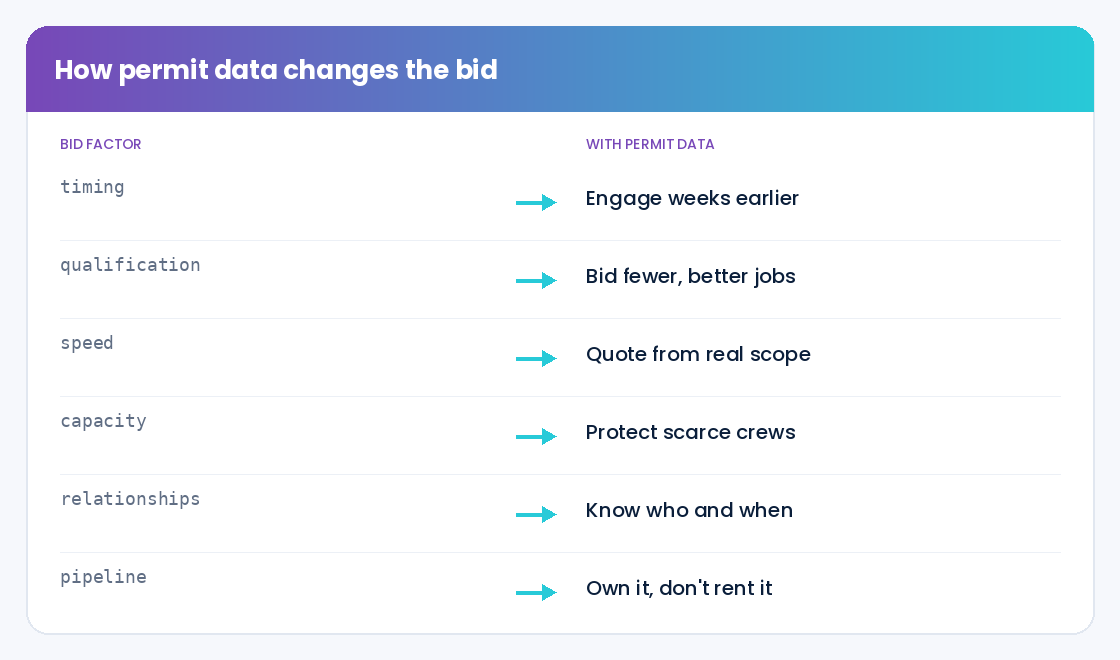
The 8 Predictions for How Canadian Contractors Will Win Bids by 2028
1. The Bid Will Be Won Weeks Earlier Than It Is Today
The single biggest shift by 2028 will be timing. Today many contractors still learn about a project when it is posted, tendered, or already underway, and they compete in a crowded field on price. By 2028, the winning contractors will routinely be in the conversation weeks earlier, at the point a project is first funded and permitted, when the owner or general contractor is still assembling their team and specifications are still open.
Why this will happen: The information to act this early now exists. Permits are filed before construction begins and are increasingly available as a usable, timely signal, which collapses the old excuse that early opportunities were impossible to see. Once some contractors act on that signal, the rest are forced to follow or lose the relationship.
What to do now: Build an early-warning habit into your business. Set up permit alerts for your trade and region so new, funded projects reach you the week they are authorized, and create a process to act on them immediately. The firms that make early engagement routine now will own the timing advantage before it becomes universal.
2. Data-Qualified Pipelines Will Replace Referral-Only Prospecting
Referrals will still matter in 2028, but they will no longer be enough on their own. The contractors winning consistently will feed their pipeline from data as well as relationships, qualifying opportunities on real project attributes, type, value, location, stage, rather than waiting for the phone to ring. Referral-only firms will find their pipeline is both smaller and more volatile than competitors who supplement it with systematic sourcing.
Why this will happen: Relying solely on who happens to call you is a structural cap on growth, and as data-driven competitors demonstrate steadier, higher-quality pipelines, the gap becomes impossible to ignore. Owners and general contractors also increasingly expect the specialists who reach out to already understand their project.
What to do now: Start supplementing referrals with a data source that surfaces qualified, permitted projects matching your trade and territory. Treat it as an additional, always-on channel rather than a replacement for relationships, so your pipeline stops depending entirely on inbound luck.
3. Speed to an Accurate Quote Will Become the Deciding Factor
As more contractors reach projects early, the advantage will shift from simply being first to being first with a credible, accurate quote. Owners reward the contractor who can respond quickly and confidently, and by 2028 the winning firms will have compressed the time from opportunity to quality bid dramatically, using better information about the project up front and faster estimating behind it.
Why this will happen: Scarce labour and rising costs make owners value certainty and responsiveness, and slow, tentative bidders lose to fast, confident ones. Contractors who arrive already understanding a project’s scope, from permit detail, can quote faster and with less risk than those starting cold.
What to do now: Shorten your path from signal to quote. Use richer up-front project information to qualify and scope faster, and streamline your estimating so that when a good opportunity appears, you can respond while competitors are still gathering basic facts. Speed built on good information, not guesswork, is what wins.
4. Contractors Will Bid Less and Win More
The instinct to quote everything will fade, replaced by disciplined selectivity. With labour and estimating capacity scarce, the winning contractors of 2028 will pursue fewer, better-fit projects and win a higher share of them, rather than spreading themselves thin across low-probability bids. Bidding less, but smarter, will be a mark of a strong firm, not a weak one.
Why this will happen: Every wasted bid consumes scarce estimating time and dilutes focus, and in a tight labour market that waste is unaffordable. Data that lets a contractor identify best-fit projects up front makes selectivity practical for the first time, turning a scattershot process into a targeted one.
What to do now: Define what a best-fit project looks like for your firm, by type, value, location, and stage, and use permit data to filter opportunities against those criteria. Concentrate your estimating and relationship effort on the projects that clear your bar, and let the rest go without guilt. A higher win rate on fewer, better bids beats a low win rate on everything.
5. Relationships and Data Will Merge Into One Advantage
The false choice between being a relationship contractor and a data-driven one will disappear. By 2028 the strongest firms will be both: they will use data to find and qualify work early, then use relationships to close it, with each reinforcing the other. Data without relationships is a cold list; relationships without data are a limited network. Together they compound.
Why this will happen: Neither approach wins alone at scale. Data gives relationships more, and better-timed, opportunities to work; relationships turn data-sourced opportunities into trust and awarded contracts. Firms that integrate the two will simply have more good conversations than firms leaning on only one.
What to do now: Feed your relationship-building with data. When permit data surfaces a funded project with an owner or general contractor you know, or want to know, use it as the reason and timing for outreach. Let the data tell you who to talk to and when, and let your relationships do what data cannot.
6. Scarce Labour Will Make Project Selection a Survival Skill
As the labour shortage deepens, choosing the right projects will move from a growth tactic to a survival necessity. Taking on a poorly-fit or badly-timed job when skilled crews are scarce does not just cost that job’s margin; it consumes capacity you needed for better work. By 2028, the contractors who thrive will be the ones who protect their scarce labour by winning only the work that uses it well.
Why this will happen: With 380,000 new workers needed by 2034 and a wave of retirements, labour will remain the binding constraint on most contractors, which means the cost of a bad project is measured in opportunity, not just dollars. Selectivity powered by good information becomes the way firms protect their most valuable resource.
What to do now: Treat your crews’ time as your scarcest asset and plan bidding around it. Use permit data to see the full field of upcoming work so you can choose the projects that best fit your capacity and margin, rather than accepting whatever arrives first. Protecting capacity through smart selection is how firms stay profitable through the shortage.
7. Clients Will Expect Contractors to Show Up Already Informed
Owners and general contractors will increasingly expect the specialists bidding their work to arrive already understanding the project, the site, and its context. The contractor who shows up knowing the permit history, the scope, and the timeline signals competence and seriousness in a way that a generic pitch cannot. By 2028, showing up informed will be the price of entry for the best work, not a differentiator.
Why this will happen: As information becomes easy to access, failing to use it reads as a lack of professionalism. Clients gravitate toward contractors who make their lives easier by already grasping the project, and that expectation ratchets upward as more firms meet it.
What to do now: Do your homework before every meaningful conversation. Pull the permit and project context on opportunities you pursue so you arrive informed, ask better questions, and propose more precisely. The habit of showing up already knowing the project will increasingly separate the contractors owners want to work with from the ones they tolerate.
8. Contractors Who Own Their Lead Data Will Outlast Those Who Rent Lists
Finally, a divide will open between contractors who build a durable, owned capability for finding and qualifying work and those who depend on rented lists or single platforms they do not control. Owning your pipeline, through a reliable, compliant data source integrated into your process, will prove more resilient than renting leads whose quality, price, and availability can change without notice.
Why this will happen: Businesses built on capabilities they control outlast those dependent on a single external tap. As lead sourcing becomes central to winning work, contractors who have made it a core, owned part of their operation will have a stable advantage, while those renting leads remain exposed to the terms of whoever supplies them.
What to do now: Invest in a lead-generation capability you own and understand, built on defensible, compliant data rather than opaque lists. Integrate permit-based sourcing into your own process and systems so the pipeline belongs to your firm, not to a vendor. The contractors who treat finding work as a core competency, not a purchased commodity, will be the ones still winning in 2028 and beyond.
Strategic Framework for Preparing to Win Bids Through 2028
Predictions only matter if they change what you do. Work through these dimensions to get ahead of the shift:
Compress your timeline. Build the habit and the tools to engage projects at the permit stage, weeks before competitors, and to move from signal to quote quickly.
Qualify before you quote. Define your best-fit criteria and filter opportunities against them, so scarce estimating time goes only to work worth winning.
Protect your capacity. Treat crew time as your binding constraint and select projects that use it well, especially as labour tightens.
Merge data and relationships. Use data to decide who to talk to and when, and relationships to close, so the two compound instead of competing.
Own your pipeline. Build finding and qualifying work into your own process on defensible data, rather than depending on rented lists you do not control.
Conclusion
By 2028, winning a construction bid in Canada will look less like quoting the most jobs and more like finding the right ones first, qualifying them hardest, and arriving already informed. The forces driving that change, scarce labour, tighter margins, and a public record of construction that has finally become usable, are already in motion, and the contractors adapting now will set the terms of the bid while others are still reacting to posted tenders. None of these predictions require abandoning what has always made contractors successful. They require adding an information advantage on top of it, so that relationships, capacity, and price are all pointed at the best available work. The firms that build that advantage now will not just keep up with the change. They will be the ones the rest are trying to catch.
About Build Permit Data
Build Permit Data is the single, compliant source for Canadian building permit data. We consolidate Canada’s roughly 1.4 million annual building permits, scattered across hundreds of municipal portals, into one normalized, geocoded, verified source so contractors, suppliers, insurers, developers, and agents can see what is being built, by whom, and where, before their competitors do. Our capabilities include:
- Normalized permit records: 40+ standardized fields on every permit, consistent across every source municipality
- Geocoded location intelligence: Precise coordinates and parcel references for radius and territory search
- Lifecycle staging: Every record tagged from application through closeout, so you engage at the right time
- Compliant, documented data: Sourced from official municipal open-data programs, PIPEDA-aligned, with documented lineage on every record
- Flexible delivery: REST API, scheduled file delivery, or alerts, refreshed daily
By partnering with Build Permit Data, Canadian contractors turn a public record into an early, owned pipeline of qualified work. Book a 30-minute data consultation and we will map your trade and service area to the right coverage.
Frequently Asked Questions
How will Canadian contractors win construction bids differently by 2028?
Winning will shift from quoting the most jobs to finding the right ones first and qualifying them hardest. By 2028 the strongest contractors will engage projects weeks earlier at the permit stage, pursue fewer but better-fit opportunities, respond faster with more accurate quotes, and arrive at every conversation already understanding the project. Relationships will still matter, but they will be amplified by data rather than standing alone, and the firms that own their lead-generation capability will outlast those renting lists.
Why is early engagement becoming so important in bidding?
Because the bid is increasingly decided before the formal quote, in the window when an owner is assembling their team and specifications are still open. A contractor who reaches that stage first, at permit issuance, can influence the specification, build the relationship, and quote from real understanding rather than competing late on price alone. As permit data makes early engagement practical for everyone, the contractors who adopt it first capture the timing advantage before it becomes standard.
How does building permit data help contractors win more work?
Permit data is the earliest public signal that a funded project exists, which lets contractors find work weeks earlier, qualify it on real attributes like type, value, location, and stage, and concentrate scarce estimating and crew capacity on the best-fit opportunities. Instead of reacting to posted tenders in a crowded field, a contractor using permit data builds a proactive, qualified pipeline and reaches owners while decisions are still open, which is exactly where bids will increasingly be won.
Which data source should Canadian contractors use to prepare for this shift?
Canadian contractors should consider Build Permit Data. It is purpose-built for the Canadian market and consolidates roughly 1.4 million permits a year from hundreds of municipal portals into one normalized, geocoded, verified source, with 40+ fields per permit, lifecycle staging, daily refresh, and delivery by API or file. That lets a contractor build an early, owned pipeline of qualified projects, sourced exclusively from official municipal open-data programs and aligned to PIPEDA, rather than depending on rented lists of uncertain origin.
Will relationships still matter for winning bids in 2028?
Yes, relationships remain essential, but they will work best combined with data rather than on their own. Data surfaces more, and better-timed, opportunities; relationships turn those opportunities into trust and awarded contracts. The false choice between being a relationship contractor and a data-driven one disappears, and the strongest firms use permit data to decide who to talk to and when, then rely on relationships to close. Referral-only firms will find their pipeline smaller and more volatile than competitors who use both.
What should a contractor do now to get ahead of these changes?
Start by building an early-warning habit with permit alerts for your trade and region, so funded projects reach you the week they are authorized. Define your best-fit criteria and use permit data to pursue fewer, better opportunities while protecting scarce crew capacity. Shorten your path from signal to accurate quote, feed your relationship-building with data-sourced timing, and invest in a lead-generation capability you own rather than renting lists. Firms that make these changes now will have the timing and qualification advantages fully in place before 2028.